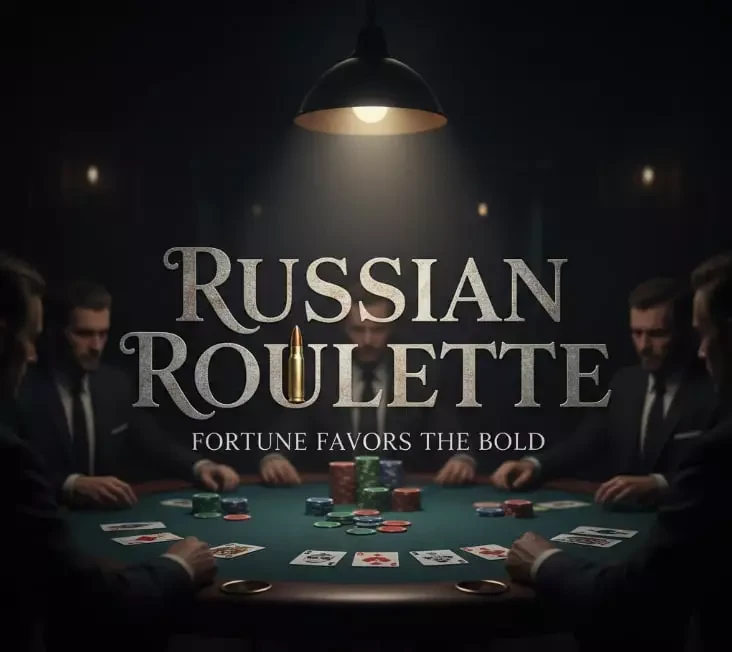
The russian roulette game has long captured public imagination—not because it is widely played or connected to casino gambling, but because it represents one of the most extreme psychological symbols associated with risk and decision-making. Despite its name, the russian roulette game is not a casino roulette variant. Instead, it is commonly understood as a metaphor used to describe situations involving extreme uncertainty and irreversible consequences.
When people search for the russian roulette game, they are rarely looking for rules or instructions. More often, they are drawn to the emotions, mental tension, and philosophical questions it raises about risk, control, and survival. This article explores why the russian roulette game continues to fascinate audiences, focusing on three core psychological drivers that explain its lasting cultural impact.
Table of contents [Show]
The Curiosity Toward Extreme Risk
Extreme risk has a unique psychological pull, and the concept of russian roulette sits at the far end of that spectrum. Unlike conventional games that involve gradual rewards or calculated odds, this idea compresses danger into a single, dramatic moment. People are drawn to extreme-risk scenarios because they:
- Break away from everyday, predictable choices
- Create heightened emotional awareness
- Trigger adrenaline without requiring long-term engagement
In this context, curiosity is not about winning money. It is about confronting the idea of irreversible consequences in a controlled, symbolic setting—even if that sense of control is only perceived.
Life-or-Death Choices as a Simplified Decision Model
One reason the russian roulette game remains culturally powerful is its reduction of complex life decisions into a binary outcome: survival or loss. This simplification resonates strongly in a world filled with ambiguous choices and delayed consequences. By presenting a stark either-or scenario, the concept mirrors how people emotionally experience high-pressure moments. The appeal lies in clarity, not comfort.
Why Binary Outcomes Feel So Compelling
Binary decision frameworks are psychologically attractive because they:
- Reduce overthinking and analysis paralysis
- Focus attention on the present moment
- Create emotional intensity without prolonged uncertainty
In contrast to strategy-heavy games, the russian roulette metaphor offers instant resolution. This clarity is unsettling—but also strangely reassuring to individuals overwhelmed by complexity.
Control Versus Randomness: The Core Psychological Tension
At the heart of the russian roulette game is a paradox: people feel both powerless and in control at the same time. This tension is central to its fascination. On one hand, outcomes are driven entirely by randomness. On the other, engaging with the idea creates an illusion of agency. This conflict closely reflects how individuals navigate uncertainty in real life.
How Perceived Control Shapes Risk Thinking
Psychological research consistently shows that people tolerate risk more easily when they feel involved in the decision-making process—even when outcomes are random. In discussions surrounding the russian roulette game, perceived control often appears as:
- Choosing whether to engage with the concept
- Acknowledging the risk knowingly
- Framing uncertainty as a personal mental challenge
Platforms such as Nustabet recognize this dynamic and emphasize informed choice, transparency, and player awareness rather than reckless behavior.
Cultural Influence and Symbolic Meaning
Beyond psychology, the russian roulette game has become a recurring symbol in films, literature, and online discourse. It represents ultimate risk, existential choice, and the fragile boundary between chance and consequence.
This symbolic weight explains why interest persists even among people who never intend to participate in any real-world equivalent. Searching for the russian roulette game is often an act of exploration, not intention.
Who Is Drawn to This Concept?
Fascination with the russian roulette idea often appeals to:
- Individuals curious about extreme psychological states
- Audiences interested in moral or existential themes
- Readers exploring how humans respond to high-stakes uncertainty
Understanding this distinction is essential for responsible platforms like Nustabet, which focus on informed engagement rather than shock value.
The russian roulette game endures not because it is practical or widely practiced, but because it distills profound psychological questions into a single, unforgettable concept. It challenges how people think about risk, control, and consequence in a way few metaphors do.
For those researching the psychology of risk-based decision-making or examining how individuals respond to uncertainty, structured environments that prioritize transparency and awareness—such as those discussed by platforms like Nustabet—offer a more responsible context for exploration. High-risk concepts should always be approached with clarity, context, and caution.